




Teams ship random articles and wonder why rankings and AI citations lag.
You need a template that ties goals, pillars, briefs, schema, and ops together.
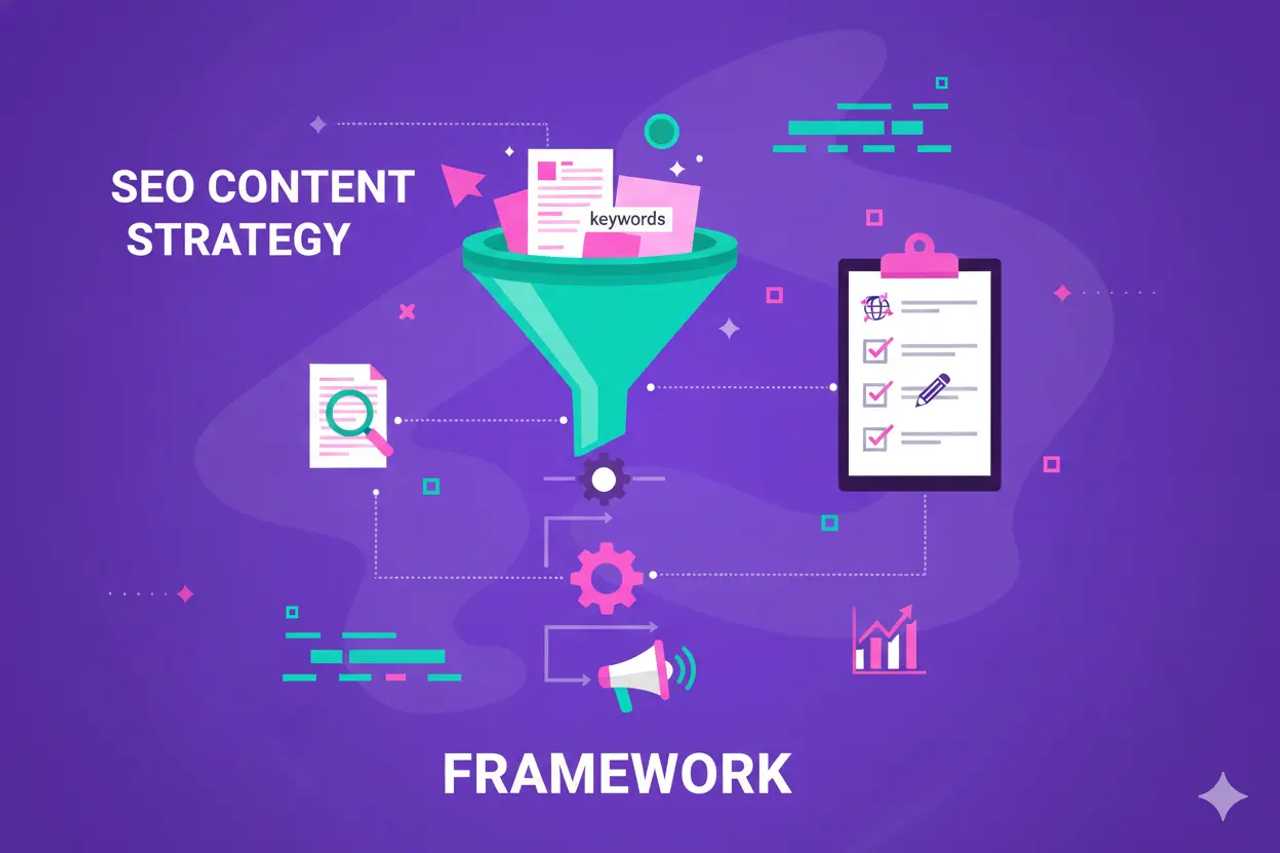
In this guide you will learn a step-by-step SEO content strategy template built for AI search, with fields you can drop into your docs or Notion.
This matters because assistants and Google reward coherent clusters, clear entities, and consistent execution.
Pair this with our content strategy pillar at Content Strategy SEO to keep every piece aligned.
Template overview (sections to include)
Goals and KPIs
Audience and jobs-to-be-done
Pillars and clusters
Keyword and intent map
Entities and anchor library
Content formats and schema plan
Governance and roles
Workflow and cadences
Measurement and dashboards
30-60-90 roadmap
Goals and KPIs
Business goals: pipeline, bookings, revenue, or signups.
Search/AI goals: AI citation share, SERP share of voice, rich results, CTR, conversions.
Operational goals: velocity, cycle time, QA pass rate, and refresh cadence.
Set targets per quarter; tie each to clusters.
Audience and jobs-to-be-done
Personas with pains, triggers, and desired outcomes per market.
Questions they ask in SERPs and AI assistants; include top People Also Ask and prompt logs.
Buying stages: awareness, consideration, decision; map CTAs accordingly.
Preferred formats and channels per persona (guides, comparisons, calculators, video).
Pillars and clusters
List pillars with summaries, primary queries, and success metrics.
For each pillar, list supports: intent, target queries, entity focus, and CTA.
Note cannibalization risks; assign canonical pages.
Add internal link rules: pillar ↔ supports, sibling links, approved anchors.
Include hreflang pairs and local variations where relevant.
Keyword and intent map
Primary and secondary queries per page; include conversational variants for AI answers.
Intent tags (informational, comparison, transactional, local) and funnel stage.
SERP/AI features observed: AI Overview, PAA, snippets, video, local pack.
Competitor pages and gaps; note where you can add proof or tools.
Entities and anchor library
Core entities per pillar (products, problems, industries, regulations, integrations).
about/mentionstargets for schema and copy.Anchor phrases to use and avoid; keep 2–6 words and intent-led.
SameAs sources for Organization, authors, products, and locations.
Content formats and schema plan
Format per page: guide, comparison, checklist, tool, case study, FAQ, video, or interactive.
Schema types: Article/BlogPosting + Person/Organization minimum; add FAQ/HowTo/Product/SoftwareApplication/LocalBusiness/VideoObject as needed.
Media plan: required screenshots, charts, or demos; alt text and transcripts.
Speakable for concise summaries where safe; note YMYL exclusions.
Governance and roles
RACI for research, briefs, writing, editing, schema, design, QA, publish, and refresh.
Approval steps for YMYL and regulated content; reviewers with credentials.
Change log for anchors, templates, and schema IDs; owners per cluster.
Offboarding rules for authors and reviewers to avoid entity drift.
Workflow and cadences
Weekly: standups, brief approvals, QA queues, AI prompt checks.
Biweekly: sprint planning; publish goals; experiments on titles, intros, and schema.
Monthly: refresh high-value pages; update dashboards; adjust anchors and intent maps.
Quarterly: audit clusters, hreflang, schema coverage, and decay; re-prioritize roadmap.
Measurement and dashboards
Visibility: impressions, CTR, rich results, AI citations per cluster.
Engagement: scroll, internal link CTR, exits, and time on page.
Conversion: leads/bookings/sales per cluster; assisted conversions.
Lifecycle: time-to-first-click, decay rate, refresh uplift.
Ops: velocity, cycle time, QA pass rate, schema validation, agent acceptance.
Localization: performance by market, hreflang health, local AI citations.
Risk and compliance
YMYL: assign reviewers with credentials; add disclaimers and sources; log approvals.
Legal: country-specific policies and consent; ensure policy links in nav, footer, and schema.
Data: forbid AI from inventing stats; require primary sources in briefs.
Security/UX: avoid intrusive interstitials; keep CWV budgets in the template; include performance owners.
Change control: document template and schema updates; add rollback plans.
Localization plan
Mirror pillars and supports across languages while adapting examples, CTAs, and tone.
Maintain hreflang and canonical pairs; set
inLanguageand localized schema fields.Keep a glossary of approved translations for entities and anchors; list disallowed literal translations.
Assign native reviewers for YMYL; store reviewer names and dates in briefs.
Track metrics per market; adjust intros and FAQs based on local AI citations and CTR.
Experiment backlog (examples)
Answer-first vs question-first intros; measure CTR and citations.
FAQ placement tests; observe AI Overview presence and snippet wins.
Speakable on non-YMYL summaries; validate outputs and measure citations.
Internal link block variations; track internal CTR and dwell.
Title/meta rewrites with benefit-led copy; test across top landing pages.
Tool stack
Research: keyword tools, Search Console exports, PAA scrapers, AI prompt logs.
Planning: Notion/Sheets/Jira for roadmap, briefs, anchor logs, and decision logs.
Production: CMS with structured fields for schema, author/reviewer IDs, and localization.
QA: crawlers for links and schema, Playwright for rendered checks, Lighthouse for CWV.
Analytics: GA4, Search Console, warehouse + Looker Studio dashboards by cluster and market.
Template blocks to add
Decision log: what changed, why, owner, date, expected impact.
Risk log: YMYL topics, legal concerns, and mitigations.
Resource plan: roles, hours, and budget per cluster and market.
Refresh tracker: page, last update, decay signals, and next refresh date.
Content refresh plan
Identify decay: drops in clicks/CTR, AI citations, or outdated claims.
Re-brief with new queries, entities, and proof; update anchors and internal links.
Refresh schema and
dateModified; retest prompt outputs and AI citations.Measure uplift after 2–4 weeks; prioritize the next batch by impact.
Reporting rhythm
Weekly: publishes/refreshes vs plan, blockers, and quick wins.
Monthly: cluster performance, AI citations, decay alerts, and ops metrics.
Quarterly: roadmap reset, localization review, experiment results, and resource needs.
Executive one-pager: KPIs vs target, top risks, and next actions with owners.
Template snippets you can copy
Brief header: page title, goal, persona, stage, queries, entities, CTA, author, reviewer, schema types, anchors, due dates.
Roadmap table: page, intent, owner, status, publish date, refresh date, KPI target.
Anchor log: source page, target page, anchor used, date added, owner.
Prompt log: query, assistant, output summary, URLs cited, action taken.
Case snippets
SaaS: Used the template to align integration clusters; AI citations rose 24% and demo conversions improved 9%.
Ecommerce: Added schema and anchor plans per product pillar; rich results expanded and organic revenue grew 8%.
Health publisher: Governance and reviewer fields reduced QA failures; AI Overviews began citing YMYL guides, boosting appointments 12%.
Roles to list in the template
SEO lead: owns pillars, schema standards, measurement, and approvals.
Content strategist: maps intent to pages, maintains anchor library, and writes briefs.
Writer/editor: produces answer-first content, adds proof, and enforces anchors.
Designer/UX: ensures readability, TOC, media, and CWV-friendly layouts.
Developer: templates, schema rendering, hreflang, and monitoring.
Localization lead: adapts content and anchors, manages hreflang, and native QA.
Legal/compliance: YMYL review, disclaimers, policy updates.
PR/comms: feeds coverage and quotes into sameAs and content updates.
KPIs and targets per stage
Visibility: impressions, CTR, rich results, AI citations; target lift per quarter by cluster.
Engagement: scroll depth >50%, internal link CTR >8–12% on informational pages.
Conversion: leads/bookings per cluster; assisted conversions; target uplift post-refresh.
Lifecycle: time-to-first-click under 14–30 days; decay rate improvements after refresh.
Ops: velocity (publishes/week), QA pass rate >90%, schema validation errors trending down.
Sample worksheet columns
Page title, URL, pillar/support, intent, stage, primary/secondary queries, entities, schema types, anchors, CTA, author, reviewer, status, publish date, refresh date, KPI target, notes.
For localization: language/market, hreflang target, local CTA, local examples, glossary compliance, reviewer name/date.
Budgeting in the template
Estimate hours for research, writing, editing, design, dev, localization, and QA per page.
Add budget rows for tools (crawlers, prompts, analytics), media, and PR support.
Prioritize clusters by revenue impact and decay; fund YMYL markets with reviewer time.
Track actuals vs estimates; adjust future sprints based on variance.
Training and enablement
Include links to style guide, schema library, anchor lists, and prompt library.
Schedule monthly training on answer-first writing, anchors, and E-E-A-T.
Quarterly schema and CWV refreshers for dev/SEO; localization sessions for market teams.
Store recordings and quickstart checklists in the template for new hires.
Example scheduling view
Week-based calendar: briefs due Monday, drafts Wednesday, edits Friday, QA Monday, publish Wednesday, prompt tests Thursday.
Include buffer for YMYL reviews and localization lag.
Flag code freezes or holidays per market to adjust timelines.
Prompt bank for strategy tasks
“List top questions and intents for [pillar] for [persona] in [market].”
“Draft 5 H2/H3 ideas that match AI assistant phrasing for [topic].”
“Suggest entities and
about/mentionsfor [topic] tied to these products/regulations: [list].”“Rewrite this intro to answer [query] in two sentences with a data point.”
“Propose internal links and anchors from this draft to these targets.”
Always log prompts and edits; update the library with accepted versions.
Executive reporting built into the template
Monthly one-pager: KPIs vs targets, AI citations, top wins, risks, and next actions.
Screenshots of SERP/AI Overview changes for priority queries.
Budget vs actuals and capacity needs for next quarter.
Risk register updates (YMYL, legal, technical) with owners and due dates.
Incident handling
If content ships with errors, publish correction, update schema, and log changes.
If AI assistants misstate facts, add clarifying copy and sources near the intro; rerun prompts.
If schema fails, roll back template changes, fix IDs, and revalidate.
Record incidents in the template with cause, fix, and prevention steps; review quarterly.
Localization specifics in the template
Add fields for local CTA, examples, currencies, and support hours.
Include hreflang targets and canonical rules per market.
Track glossary compliance and localization QA notes per page.
Add localized prompt tests (“How do assistants answer [query] in [language]?”) with links to outputs.
Report AI citations and CTR by market to refine intros and anchors locally.
30-60-90 plan to deploy the template
30 days: define goals, personas, pillars, and supports; create brief and roadmap templates; set dashboards.
60 days: publish first wave of pillars/supports with schema; launch prompt logging; enforce anchors and internal link rules.
90 days: refresh top pages, fix decay, localize priority markets, and integrate PR wins into sameAs and schema.
Data and PR integration
Note data sources and update cadences in the template so stats stay fresh.
Add PR/coverage fields to record new mentions and links; update sameAs and anchors accordingly.
Tie brand/author queries and Knowledge Panel changes to PR and content releases for reporting.
How AISO Hub can help
AISO Audit: We assess your current content strategy, clusters, schema, and AI visibility, then provide a prioritized template.
AISO Foundation: We build your content strategy template, brief system, and governance so every piece ships right.
AISO Optimize: We execute the roadmap, add schema and links, and test intros for AI citations and conversions.
AISO Monitor: We track KPIs, AI citations, and decay, alerting you when the strategy drifts.
Conclusion: one template, repeatable wins
A strong content strategy template keeps goals, pillars, anchors, schema, and ops in one place.
Use it to brief, publish, refresh, and measure without guessing.
Tie everything back to the content strategy pillar at Content Strategy SEO and you will ship faster, earn more citations, and convert more readers.