




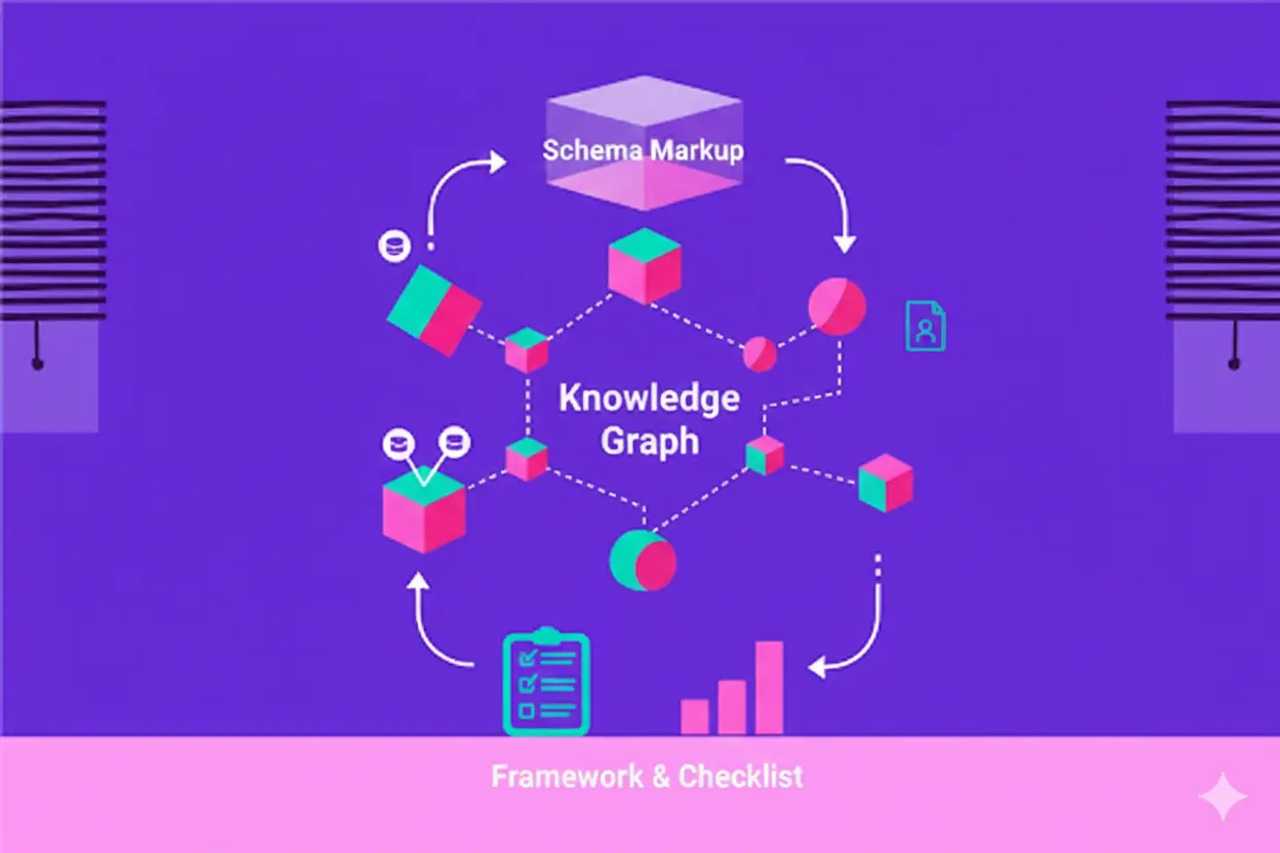
Schema markup becomes powerful when it forms a connected knowledge graph of your brand.
Here is the direct answer up front: define your key entities, give them stable @id values, link them with about/mentions and sameAs, implement JSON-LD across templates, and govern the graph with validation and monitoring.
This guide shows how to model, implement, and measure a schema-driven knowledge graph that improves AI citations, rich results, and entity clarity.
Keep our Structured Data and AI Search Ranking Factors pillars open as you build.
What is a schema-driven knowledge graph?
It’s the set of entities (Organization, Person, Product, LocalBusiness, Article, FAQ, HowTo) and relationships on your site expressed in JSON-LD.
With stable @id URIs and sameAs links, these nodes form a graph that search engines and AI assistants can traverse.
The result: clearer attribution, fewer mis-citations, and better eligibility for AI Overviews and rich results.
Why it matters for AI search
- AI assistants need unambiguous facts; a graph reduces hallucinations and wrong-language citations.
- Connected entities (author → organization → article → product) increase trust signals (E-E-A-T) and citation odds.
- Graph clarity helps AI choose the right URL for each locale and topic, improving accuracy and conversions.
- Fresh, consistent schema signals recency to assistants that prioritize up-to-date answers.
AISO Entity Graph Framework (5 steps)
- Discover: Inventory entities (brand, people, products/services, locations, categories, core topics). Crawl current schema to find gaps and errors.
- Model: Define @id patterns, sameAs sources, about/mentions usage, and relationships (e.g., Person authors Article; Product belongs to Category; LocalBusiness serves Area).
- Implement: Build JSON-LD templates per type; map CMS/PIM fields; deploy via templates or data layer; validate.
- Govern: Version control, CI linting, changelog, quarterly audits, and ownership for fixes.
- Measure: Track errors, rich results, AI citations, accuracy, and entity-level KPIs; iterate.
Entity inventory (worksheet-style)
- Organization: name, url, logo, contactPoint, sameAs, foundingDate, address.
- Persons (authors/experts): name, jobTitle, affiliation, url, sameAs (LinkedIn/speaker pages), knowledgeArea.
- Products/Services: name, description, brand, sku/gtin, category, offers (price, currency, availability), related products.
- Locations (LocalBusiness): name, address, geo, openingHours, areaServed, sameAs, priceRange.
- Content nodes: Article/BlogPosting with about/mentions; FAQPage for common questions; HowTo for steps.
- Categories/concepts: glossary terms, categories, or solutions you want to own; treat as entities with IDs.
List them, assign owners, and decide which appear publicly.
@id patterns and consistency
- Use stable, unique IDs:
https://example.com/#org,https://example.com/authors/jdoe#person,https://example.com/products/widget-123#product. - Keep IDs consistent across locales; localize labels, not IDs.
- Reference IDs across pages (Article → Person → Organization) to form edges in the graph.
- Avoid changing IDs; treat them like primary keys.
Linking entities: about, mentions, sameAs
- about: Primary entity the content is about (e.g., Product or topic).
- mentions: Related entities discussed.
- sameAs: External authoritative profiles (LinkedIn, Crunchbase, Wikidata, GBP, press) to reinforce identity.
- Use these properties consistently to show relationships and reduce ambiguity.
Example: connected Article, Person, Organization, Product
{
  "@context": "https://schema.org",
  "@graph": [
    {
      "@type": "Organization",
      "@id": "https://example.com/#org",
      "name": "Example Co.",
      "url": "https://example.com/",
      "logo": {"@type": "ImageObject","url": "https://example.com/logo.png"},
      "sameAs": ["https://www.linkedin.com/company/example","https://www.crunchbase.com/organization/example"]
    },
    {
      "@type": "Person",
      "@id": "https://example.com/authors/jdoe#person",
      "name": "Jamie Doe",
      "jobTitle": "Head of SEO",
      "affiliation": {"@id": "https://example.com/#org"},
      "url": "https://example.com/authors/jdoe",
      "sameAs": ["https://www.linkedin.com/in/jamiedoe"]
    },
    {
      "@type": "Product",
      "@id": "https://example.com/products/widget-123#product",
      "name": "Widget 123",
      "brand": "Example Co.",
      "category": "Analytics",
      "offers": {"@type": "Offer","price": "49.00","priceCurrency": "EUR","availability": "https://schema.org/InStock","url": "https://example.com/products/widget-123"}
    },
    {
      "@type": "Article",
      "@id": "https://example.com/articles/ai-search#article",
      "headline": "AI Search Ranking Factors: 2025 Guide",
      "author": {"@id": "https://example.com/authors/jdoe#person"},
      "publisher": {"@id": "https://example.com/#org"},
      "datePublished": "2025-02-01",
      "dateModified": "2025-03-10",
      "mainEntityOfPage": "https://example.com/articles/ai-search",
      "about": [{"@id": "https://example.com/products/widget-123#product"}],
      "mentions": [{"@id": "https://example.com/#org"}]
    }
  ]
}
This shows nodes and links via @id, forming a small graph.
From snippets to graph: maturity stages
- No schema: Machines guess; high ambiguity.
- Single-page snippets: Basic markup, no links between entities.
- Template coverage: Consistent schema per type, some linking to Organization/Person.
- Graph-linked: IDs reused; about/mentions used; sameAs complete; entities tied together across pages.
- Data-driven graph: Central entity store feeds JSON-LD; multilingual alignment; monitoring and KPIs in place.
Aim for Stage 3–4 for AI search readiness.
Building the graph: step-by-step
- Audit: Crawl current schema; list entities and detect duplicates/conflicts; note missing required fields.
- Design: Decide @id scheme, sameAs sources, required/recommended properties per type, about/mentions patterns, and locale handling.
- Implement: Create JSON-LD templates; map CMS/PIM fields; add @graph blocks where needed; avoid duplicate injection.
- Validate: Rich Results Test, Schema Markup Validator; crawl samples; check assets (logos/authors) return 200.
- Deploy: Staging first; feature flag if possible; monitor Search Console and logs for errors.
- Monitor: Track errors/warnings, rich results, AI citations, accuracy; keep changelog.
- Iterate: Expand to more entities (events, docs, integrations); refine relationships; update sameAs as profiles grow.
Prioritizing entities for business impact
- Revenue-driving pages: products/services, pricing, comparison pages.
- Trust pages: about, authors, policies, security/compliance.
- Support/help content: FAQs/HowTo; reduce mis-citations and improve deflection.
- Local pages: NAP consistency and LocalBusiness for each location.
- Integrations/partners: integration entities with sameAs to partner docs; improves relevance for “
+ ” prompts.
Multilingual and multi-location graphs
- Keep IDs stable across locales; localize labels and descriptions; use inLanguage.
- Hreflang aligned with canonicals; ensure schema language matches page language.
- Locale-specific sameAs (local directories, press, LinkedIn/GBP per market).
- LocalBusiness per location with distinct @id; areaServed in local language.
- Validate per locale; monitor wrong-language citations and fix hreflang/schema mismatches fast.
Governance and ownership
- Owners: SEO/Schema lead, developer, content/SME, analytics, and legal for YMYL.
- Registry: entity list with IDs, sameAs, properties, locales, and owners.
- Versioning: store templates in Git; code review required.
- CI linting: block deploys on critical schema errors or missing required fields.
- Changelog: date, URL/template, change, owner, prompts to retest, outcome.
- Audits: quarterly coverage/consistency checks; asset health; dateModified freshness.
Measurement and KPIs
- Schema error/warning counts by template.
- Rich result impressions/CTR by type (FAQ, HowTo, Product, Breadcrumb, Article).
- AI citation inclusion/share for graph-linked pages; accuracy on pricing/availability/bios.
- Entity consistency score: % of entities with complete sameAs and correct reuse of @id.
- Wrong-language citation incidents; time to fix.
- Freshness: % of priority pages updated (content + schema) in last 45 days.
- Conversions on cited pages vs baseline; assisted conversions after citation gains.
Tools and workflows
- Crawlers (Screaming Frog/Sitebulb) with custom extraction to see @id, types, and relationships.
- Validators: Rich Results Test, Schema Markup Validator, CI linters.
- Graph views: export @graph data to visualize connections (e.g., using lightweight scripts or graph DB visualizers).
- Dashboards: combine schema errors, rich result metrics, AI citations, and conversions; add alerts.
- Prompt panels: test priority queries weekly to see how assistants cite and describe your entities.
Common pitfalls and fixes
- Duplicate IDs or mismatched names: Standardize naming; keep @id stable; update glossary.
- Plugin conflicts: Disable overlapping schema sources; consolidate to one template.
- Hidden or non-existent content marked up: Only mark visible, real data.
- Stale prices/dates: Sync with CMS/PIM; update dateModified with actual edits.
- Broken assets (logos/authors): Monitor 4xx/5xx; fix fast.
- No relationships: Add about/mentions and reuse @id to connect nodes; don’t leave isolated snippets.
- No sameAs: Add authoritative links to reduce ambiguity.
AI assistant testing prompts (use weekly)
- “Who is
and what do they offer in Portugal?” - “Who writes
’s articles about ?” - “Is
available in and what are their hours?” - “Compare
with for - “What integrations does
have with ?”
Log citations, wording, and accuracy; fix schema/content when answers are wrong.
Case snapshots (anonymized)
- B2B SaaS: Moving to @graph-based templates and completing sameAs for authors/org lifted Perplexity citation share from 10% to 26%; demo conversions on cited pages +11%.
- Local multi-location: Distinct @id per location, localized sameAs, and LocalBusiness + Service schema shifted Copilot citations from directories to the brand; calls +17%.
- Ecommerce: Product + Offer + FAQ with consistent IDs and daily price updates cut ChatGPT pricing errors to zero and restored AI Overview inclusion for three categories.
Risk management
- Wrong sameAs links can misattach entities; review sources and approvals.
- Changing @id breaks relationships; treat IDs as permanent.
- Over-marking unrelated entities confuses assistants; keep about/mentions focused.
- For YMYL, keep reviewer notes, disclaimers, and credentials current; monitor accuracy more often.
- Align with legal/privacy when exposing data; avoid PII in schema.
30/60/90-day graph plan
First 30 days
- Audit current schema; fix critical errors; set @id pattern; build entity inventory.
- Implement Organization + Person + Article with about/mentions; remove duplicates.
- Add linting in CI; start changelog; run baseline prompt panels.
Next 30 days
- Roll Product/Service, FAQ/HowTo, LocalBusiness where relevant; localize schema fields.
- Add sameAs across entities; tie partners/integrations via mentions.
- Visualize graph connections; ensure IDs reused across pages.
- Monitor rich results and AI citations; fix inaccuracies.
Final 30 days
- Automate schema generation from CMS/PIM where possible; block deploys on errors.
- Expand to integrations/events if relevant; add glossary entities.
- Build dashboards for schema errors, entity consistency, rich results, and AI citations.
- Document governance and review cadence; train teams.
Governance and documentation
- Entity registry: IDs, labels, sameAs, owners, locales, and relationships.
- Schema registry: templates per type, required/recommended fields, and update cadence.
- Change control: code review for schema; changelog entries with prompts retested.
- CI linting: block deploys on critical schema errors or missing required fields.
- Audit cadence: quarterly checks on coverage, consistency, asset health, freshness, and wrong-language citations.
- Access controls: limit who edits schema/robots to reduce accidental changes.
Auditing the graph
- Crawl to extract @id, @type, sameAs, about/mentions; check for duplicates and missing edges.
- Verify Organization/Person nodes exist and are reused across pages; fix broken logos/bios.
- Check glossary alignment: entities named consistently; no variant spellings in IDs.
- Compare schema to content for prices, dates, authors; fix mismatches.
- Validate hreflang/inLanguage for localized entities; ensure local sameAs where available.
- Visualize @graph to spot isolated nodes and overlinked noise; adjust about/mentions accordingly.
Analytics and KPIs (entity-level)
- Error/warning counts per template and entity type.
- Entity consistency score: % of entities with complete sameAs and reused IDs.
- AI citation inclusion/share for entity-focused prompts; accuracy of brand/product facts.
- Wrong-language or wrong-URL citations; time to fix.
- Rich result impressions/CTR for pages tied to specific entities (products, authors, locations).
- Conversions on cited pages linked to key entities; assisted conversions after citation gains.
Localization and multi-market nuances
- Keep IDs stable across locales; localize labels and descriptions; align hreflang and inLanguage.
- Use locale-specific sameAs (local directories/press/LinkedIn/GBP) where available.
- Ensure LocalBusiness entities have localized address/phone formats; priceCurrency per market.
- Run prompt panels per language; log wrong-language citations and fix schema/hreflang.
- Maintain a locale glossary to avoid mistranslated entity names; sync with translators.
Integrating other data sources
- Pull product data from PIM and map to Product/Offer IDs; keep prices/availability fresh.
- Use CRM/help desk data to create entities for key docs or support topics; map to FAQ/HowTo.
- Connect integration partners via sameAs to official docs; improves “
+ ” queries. - Keep data contracts: which source owns prices, bios, hours; reduce conflicting updates.
Experiment backlog
- Add glossary entities and mentions to top 20 articles; measure citation share for those topics.
- Test deeper linking between products and integrations; watch AI answers for improved relevance.
- Localize sameAs and inLanguage on top locales; track wrong-language citation reduction.
- Add speakable to key definitions; see if AI uses cleaner summaries.
- Optimize @id patterns and reduce duplicates; monitor error drop and citation gains.
Reporting to leadership
- Present before/after AI citations and rich results tied to graph changes.
- Share entity consistency improvements (sameAs coverage, reduced duplicates) and their impact.
- Highlight reduced inaccuracies and wrong-language citations; note time-to-fix improvements.
- Tie graph work to conversions on cited pages and branded/entity query lift.
- Outline next bets and resource needs (automation, linting, localization QA).
How AISO Hub can help
We build AI-first knowledge graphs, not just snippets.
AISO Audit: Assess schema, entities, and relationships; deliver a prioritized graph roadmap.
AISO Foundation: Design IDs, sameAs, templates, and governance; integrate with CMS/PIM.
AISO Optimize: Expand and refine the graph, test variants, and align with answer-first content to lift citations.
AISO Monitor: Dashboards, alerts, and prompt panels to keep the graph accurate and impactful.
Conclusion
A schema-driven knowledge graph turns your site into a reliable data layer for search engines and AI assistants.
Define entities, assign stable IDs, connect them with about/mentions and sameAs, and govern the system with validation and monitoring.
Measure errors, rich results, and AI citations, and tie improvements to revenue.
When you align this work with the Structured Data and AI Ranking Factors pillars, assistants see a clear, trustworthy map of your brand.
If you want a partner to design, implement, and monitor your knowledge graph without slowing releases, AISO Hub is ready to audit, build, optimize, and monitor so your brand shows up wherever people ask.