




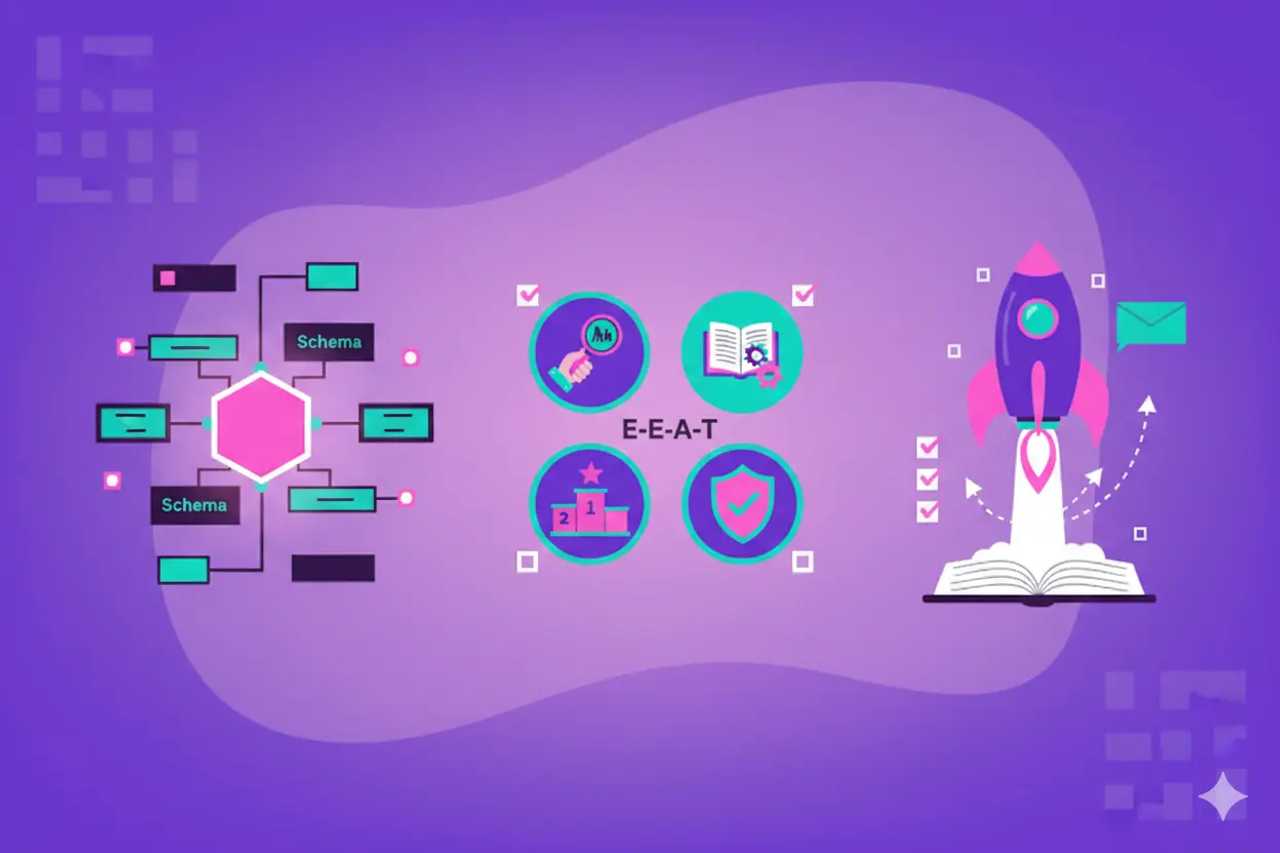
You already invest in E-E-A-T signals, but without schema you force Google and AI assistants to guess who you are.
Guesswork kills citations and leaves AI Overviews to pick competitors.
In this guide you will learn how to map schema types to each E-E-A-T pillar, ship JSON-LD templates fast, and keep them current across markets.
This matters because answer engines reward sources they can verify, and schema is the fastest path to verifiable proof.
Keep this playbook aligned with our E-E-A-T evidence-first pillar at E-E-A-T SEO: Evidence-First Playbook for Trust & AI so every change reinforces trust.
E-E-A-T schema matrix
Experience:
HowTo,Review,VideoObject,ImageObject,LocalBusinessphotos,Actionwith real outcomes.Expertise:
Personwith credentials,knowsAbout,EducationalOccupationalCredential,MedicalEntitywhere safe,SoftwareApplicationfor product experts.Authoritativeness:
OrganizationwithsameAs, awards asCreativeWork,Speakable,NewsArticlefor press.Trust:
Organizationcontact options,LocalBusinessNAP,ProductwithOfferparity,Reviewwith sources,FAQfor clarity,WebSitesearch actions.
Foundation schema every site needs
Organization: stable @id, logo, sameAs across LinkedIn, Crunchbase, social, and press. Include contact points and customer support channels.
WebSite:
potentialActionfor site search, default language, and alternate language URLs.Breadcrumb: keep navigation clear for crawlers and assistants.
Article or BlogPosting: linked to Person and Organization with dates and canonical URLs.
Person: authors and reviewers with job titles,
knowsAbout, credentials, and sameAs.
Layered schema by E-E-A-T maturity
Foundation: Organization, WebSite, Breadcrumb, Article + Person for authors.
Build authority: Review and Rating where valid, FAQ for clarity, Product or Service, LocalBusiness for locations.
AI-first: Speakable for short answers, HowTo for step sequences, VideoObject and ImageObject with captions and transcripts, Event for webinars, NewsArticle for press hubs.
Blueprint: Article + Person + Organization
{
  "@context": "https://schema.org",
  "@graph": [
    {
      "@type": "Organization",
      "@id": "https://example.com/#org",
      "name": "Example Health",
      "url": "https://example.com/",
      "logo": "https://example.com/logo.png",
      "sameAs": [
        "https://www.linkedin.com/company/example-health",
        "https://twitter.com/examplehealth"
      ],
      "contactPoint": [
        {
          "@type": "ContactPoint",
          "contactType": "customer support",
          "telephone": "+1-800-000-0000",
          "areaServed": "US"
        }
      ]
    },
    {
      "@type": "Person",
      "@id": "https://example.com/#dr-ana-silva",
      "name": "Dr. Ana Silva",
      "jobTitle": "Cardiologist",
      "affiliation": { "@id": "https://example.com/#org" },
      "knowsAbout": ["cardiology", "hypertension", "preventive care"],
      "hasCredential": [
        {
          "@type": "EducationalOccupationalCredential",
          "name": "Board Certified in Cardiology"
        }
      ],
      "sameAs": [
        "https://www.linkedin.com/in/dr-ana-silva",
        "https://scholar.google.com/citations?user=12345"
      ]
    },
    {
      "@type": "Article",
      "@id": "https://example.com/heart-health/#article",
      "headline": "Heart Health Checklist",
      "author": { "@id": "https://example.com/#dr-ana-silva" },
      "reviewedBy": { "@id": "https://example.com/#dr-ana-silva" },
      "publisher": { "@id": "https://example.com/#org" },
      "datePublished": "2024-11-20",
      "dateModified": "2025-01-15",
      "about": [
        { "@type": "MedicalEntity", "name": "Hypertension" }
      ],
      "mentions": [
        { "@type": "MedicalGuideline", "name": "ESC Hypertension Guideline 2024" }
      ]
    }
  ]
}
Keep @id stable and tied to canonical URLs.
Use
aboutandmentionsto align with your topic clusters and entities.Mirror credentials and bios on-page to avoid parity issues.
Schema for E-E-A-T by vertical
Clinics and YMYL health
LocalBusinessor subtype (MedicalClinic),Personfor practitioners,MedicalEntityfor conditions,Review,FAQ, andSpeakablefor common questions.Add reviewer schema and disclaimers on YMYL pages; keep dates fresh.
Link to regulators or associations in sameAs to prove licensure.
Finance and legal
Organizationwith registration numbers,Servicefor offers,Personwith licenses,Reviewwhere compliant,FAQwith disclaimers.Use
aboutto reference statutes or regulatory bodies.Keep
dateModifiedcurrent and avoid speculative claims.
SaaS and B2B
SoftwareApplicationfor products with supported platforms, pricing notes, and integration entities inoffersandknowsAbout.Article,HowTo,FAQ, andVideoObjectfor implementation guides.Productschema for add-ons;Reviewfor case studies where allowed.
Ecommerce
ProductwithOffer,Review,AggregateRating,Brand, and identifiers (GTIN, SKU).FAQfor shipping and returns,HowTofor setup,VideoObjectfor demos.Ensure price and availability parity between schema and page.
Local services
LocalBusinesswith NAP, geo, opening hours, andareaServed.Photos as
ImageObjectwith captions to show real locations.Eventfor workshops,FAQfor services, andReviewfor social proof.
Schema decision tree
Is the page about a person? Add
Personwith credentials and sameAs.Is it location-bound? Add
LocalBusinessand ensure NAP matches GBP.Does it teach a process? Add
HowToorFAQ.Is it selling a product? Add
Product,Offer, andReview.Is it thought leadership or news? Add
ArticleorNewsArticleplusSpeakable.Always link back to Organization and correct Person to consolidate authority.
Governance and change control
Create an ID registry with all @id values, owners, and last review dates.
Enforce CMS fields for authors, reviewers, credentials, and sameAs; block publish if empty.
Run CI linting for required properties per template and fail builds on duplicates or missing fields.
Keep a change log for schema template updates and track validation results.
Align with content updates so
dateModifiedreflects real edits, not template pushes.
QA and validation
Use the Schema Markup Validator and Google Rich Results Test for spot checks.
Crawl rendered HTML weekly with a headless browser to catch hydration or lazy-load gaps.
Parity checks: compare price, availability, credentials, and NAP between schema and page content.
Alert on duplicate @id values or missing sameAs across languages.
Monitoring and KPIs
Track rich result eligibility and errors by template in Search Console.
Log AI citations across AI Overviews, Perplexity, and Copilot; map to schema coverage.
Watch branded and author queries in Search Console; correlate spikes with schema releases.
Monitor Knowledge Panels for Organization and Person; note changes after schema updates.
Set freshness alerts for
dateModifiedon YMYL pages andReviewrecency.
Localization and multilingual schema
Use hreflang and localized
inLanguagefields for Article and WebSite.Localize
LocalBusinessaddresses, currencies, and phone numbers; keep sameAs aligned per market.Mirror author bios and credentials in each language; ensure @id remains stable.
Tie local offices to the parent Organization to share authority while proving local trust.
Schema to support AI Overviews and answer engines
Place concise, cited statements near the top of pages so AI systems can quote cleanly.
Add
Speakablefor short summaries where safe; test inclusion in AI Overviews.Use
aboutandmentionsto encode entities that match your topic clusters.Include
VideoObjectandImageObjectwith captions and transcripts; assistants prefer media with context.Prompt test monthly: ask “Which sources cite [topic]?” and verify your pages appear with correct titles and authors.
Common mistakes to avoid
Stuffing schema with fake reviews or inflated ratings; this erodes trust when checked.
Mixing multiple Person @id values for the same author, fragmenting authority.
Letting plugins generate conflicting Organization schema that overwrites your IDs.
Using HowTo schema for unsafe YMYL steps without reviewers or disclaimers.
Failing to update sameAs when social or PR links change, leading to dead ends.
Retrofits for legacy sites
Start with a crawl to inventory existing schema; remove duplicates and pick a canonical ID per entity.
Roll out Organization and Person templates first, then Article and LocalBusiness.
Migrate page by page: add schema to top 50 URLs by organic traffic and AI citations, then scale.
Add a governance doc to prevent regressions when templates change.
Implementation sprints
Sprint 1: Organization, WebSite, Breadcrumb, Article + Person on top 50 URLs; validation and parity checks.
Sprint 2: LocalBusiness or Product/SoftwareApplication where relevant; Review and FAQ for trust.
Sprint 3: HowTo, Speakable, VideoObject, ImageObject for high-value guides; prompt testing and AI citation logging.
Sprint 4: Localization rollout, ID registry enforcement, and CI linting baked into deploys.
Industry templates and quick starts
Healthcare: MedicalClinic LocalBusiness schema, practitioners with credentials, MedicalEntity in
about, FAQ for procedures, and reviewer fields on all advice content. Keep disclaimers and dates visible.Finance: Organization with registration numbers in
identifier, Service schema for offers, Review only when compliant, and FAQ for fees and risk statements. Link to regulators in sameAs to anchor trust.Legal: Person schema with bar numbers in
hasCredential, Service for practice areas, FAQ for jurisdiction differences, and LocalBusiness for offices. Keep correction logs for rulings that change guidance.Ecommerce: Product with identifiers, Offer parity checks, Review and AggregateRating, FAQ for shipping and returns, and HowTo for setup. Monitor price and availability parity to avoid trust loss.
SaaS: SoftwareApplication for product pages, HowTo and FAQ for setup and integrations, VideoObject for demos, and Organization schema pointing to security and uptime pages.
Dashboards and reporting
Coverage: percent of pages with required schema per template; drill down by language and market.
Validation: error and warning counts by release; trend lines to show stability.
Parity: price, availability, credentials, and NAP parity dashboards; flag deltas over defined thresholds.
AI citations: number of AI Overview or answer engine mentions per cluster; annotate schema releases to see impact.
Knowledge graph signals: new or updated Knowledge Panels for brand and authors after schema changes.
Evidence playbook for E-E-A-T via schema
Encode first-hand data: link charts to datasets using
isBasedOn; addMeasurementTechniquewhen relevant.Tie media to people: VideoObject and ImageObject should reference the author or speaker in
creator.Map reviews to real sources: link to review URLs in
sameAsto avoid suspicion of fabricated ratings.Expose policies: include
hasPolicyequivalents by linking to policy URLs in Organization and LocalBusiness content; make them visible on-page.
Testing prompts for schema impact
“Which organizations are experts on [topic]?” — check if your Organization appears after schema updates.
“Who wrote the best guide on [topic]?” — see if Person schema helps assistants name your authors.
“What is [Brand] known for?” — validate
knowsAboutand sameAs clarity.“Which clinics/shops are open now near [city]?” — confirm LocalBusiness data is accurate.
Run before and after schema releases; store outputs with timestamps and URLs cited.
Case snippets
Health publisher: Added practitioner schema and MedicalEntity mentions; AI Overview citations grew 32% and appointments rose 11%.
SaaS platform: Introduced SoftwareApplication schema and Speakable for setup guides; AI citations doubled and assisted signups increased 9%.
Retailer: Fixed Product Offer parity and added Review schema; rich result eligibility expanded and returns dropped due to clearer info.
Risk controls and compliance
Keep a prohibited list: schema types you will not use in YMYL contexts without reviewer approval.
Validate sources: for MedicalEntity and FinancialService, cite official guidelines and regulations; include links in
mentions.Avoid inflated ratings or fake reviews; they risk manual actions and damage E-E-A-T.
Set expiry reminders for credentials and licenses referenced in schema; update or remove when lapsed.
Operations checklist before every release
IDs: no new duplicates, no removed canonical IDs without redirects.
Parity: critical fields match on-page copy (dates, prices, credentials, hours).
Validation: zero errors in sample pages per template; warnings reviewed and documented.
Logs: change log updated with template version and QA results.
Monitoring: alerts configured for schema errors, citation drops, and Knowledge Panel changes.
Reporting for stakeholders
Monthly E-E-A-T Schema Score: coverage, validation pass rates, AI citations, and branded query changes.
Template-level dashboards: errors, warnings, and parity gaps with owners assigned.
Case notes: before/after examples of AI Overview citations and rich results after schema releases.
Roadmap: next sprints with expected impact and effort to keep leadership aligned.
How AISO Hub can help
AISO Audit: We assess your E-E-A-T signals, schema coverage, and AI citation gaps, then hand you a prioritized schema roadmap.
AISO Foundation: We build your ID registry, JSON-LD templates, and governance so every release ships with clean E-E-A-T schema.
AISO Optimize: We roll out templates, parity checks, and prompt testing to raise citation rates in AI Overviews and answer engines.
AISO Monitor: We track validation, AI citations, and Knowledge Panel shifts, alerting you before trust signals decay.
Conclusion: make evidence durable
Schema turns your E-E-A-T proof into machine-readable evidence that survives design changes and content growth.
Build the matrix, ship templates, and enforce governance so every page speaks clearly to Google and AI assistants.
Pair schema with strong on-page proof and off-site signals, and tie it back to the E-E-A-T pillar at E-E-A-T SEO: Evidence-First Playbook for Trust & AI to keep trust compounding.