




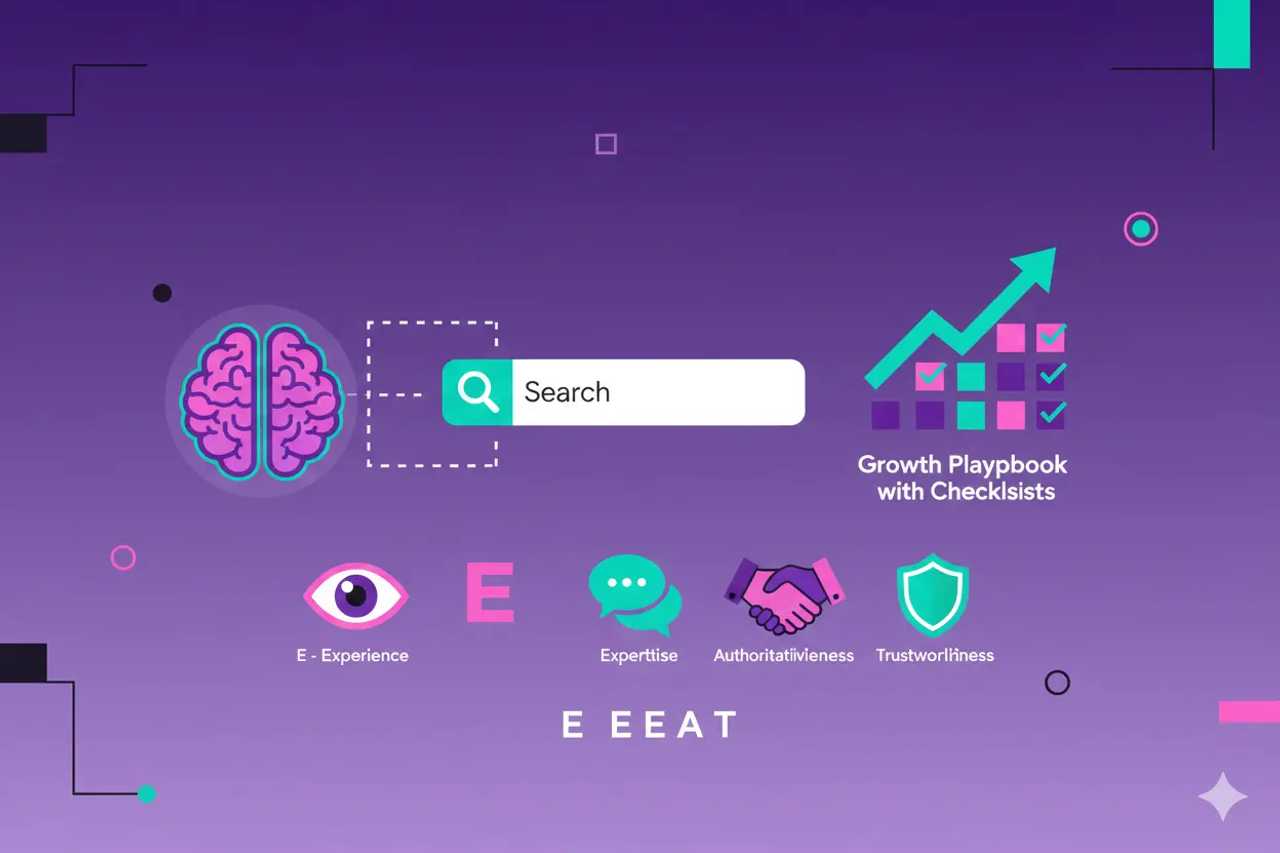
E-E-A-T drives whether AI assistants trust and cite you.
Here is the direct answer up front: show real experience, expert authorship, credible sources, and consistent entities; mark it up in JSON-LD; and monitor AI answers weekly to correct inaccuracies fast.
This guide gives you a system to build, measure, and maintain E-E-A-T for AI Overviews, Perplexity, Bing Copilot, and ChatGPT Search.
Keep our AI Search Ranking Factors guide as your north star while you work.
Introduction: E-E-A-T as an AI trust system
E-E-A-T started in Google’s quality guidelines, but AI models now lean on the same trust cues: verifiable authors, first-hand experience, clear sourcing, and consistent entities.
You need to make these signals explicit on-page and in schema, then prove them with external mentions and reviews.
This matters because AI answers shape buyer perception before they click, and weak trust signals lead to mis-citations or no citations at all.
E-E-A-T signal map for AI
Experience: First-hand demos, screenshots, data, and stories that show you actually use or build what you describe.
Expertise: Credible authors with bios, credentials, and linked profiles; clear topic focus.
Authoritativeness: External mentions, reviews, conference talks, and partner references tied back to your entities.
Trustworthiness: Accurate, current info, transparent sourcing, security/compliance notes, and clear policies.
On-site foundations
Add author bios with photos, roles, credentials, and sameAs links to LinkedIn and publications.
Publish an About page with your story, leadership, awards, and press; keep a dated boilerplate.
Surface editorial standards: how you fact-check, who reviews YMYL content, and update cadence.
Use source boxes under claims with outbound links to credible references.
Keep pricing, policies, and security pages current; add visible update dates.
Schema that carries E-E-A-T
Person: name, jobTitle, affiliation, sameAs (LinkedIn, speaker pages, research). Add knowledgeArea where relevant.
Organization: name, logo, url, sameAs (LinkedIn, Crunchbase, Wikipedia if applicable, press pages). Add foundingDate and address if relevant.
Article/BlogPosting: headline, description, author, datePublished, dateModified, about, mentions, mainEntityOfPage. Nest Person and Organization.
Review and Rating: mark visible testimonials with author and dates. Do not fabricate.
LocalBusiness (if applicable): address, geo, openingHours, sameAs, priceRange. Keep NAP consistent across directories.
FAQ and HowTo: use when you have real Q&A or steps; keep answers concise and consistent with page text.
Content patterns that prove experience
Lead with a 70–90 word answer plus a “What we did” or “What we saw” line.
Add screenshots, code snippets, or data tables with dates. Label them clearly so assistants can cite them.
Include mini case snapshots with numbers and timelines. Keep them short and source-backed.
Add “How we tested” sections that describe methods and tools.
Use comparison tables with verdicts to show decisive guidance.
External signals and entity building
Secure mentions in industry media, niche newsletters, and podcasts; link them with sameAs.
Maintain consistent naming across LinkedIn, Crunchbase, GitHub, and directories. Align bios for key authors.
Collect reviews with dates and context; surface them on relevant pages with schema.
Participate in roundups and panels; add those links to author and organization profiles.
Keep partner and certification logos current and linked to issuing bodies.
Measurement and diagnostics
Run weekly prompt panels across AI Overviews, Perplexity, Bing Copilot, and ChatGPT Search for your key topics.
Log citations, wording, and any inaccuracies. Track which authors or pages get cited.
Monitor branded and entity queries in Search Console and Bing Webmaster Tools.
Track review volume, sentiment, and new press mentions. Tie spikes to AI citation changes.
Maintain an accuracy log; fix errors by updating source pages and schema, then re-test.
Multilingual E-E-A-T
Localize bios, credentials, and testimonials for PT/FR. Do not copy English bios into other locales.
Align hreflang and localized schema fields; include inLanguage for Article and Person where relevant.
Earn local mentions and reviews; link them in sameAs where possible.
Check AI answers in each language; ensure the right locale URLs are cited.
YMYL specifics
Require expert review for health, finance, or legal topics. Add reviewer names, credentials, and review dates.
Include disclaimers and link to authoritative sources. Avoid speculation.
Keep policies and risk disclosures visible and current.
Monitor YMYL prompts more frequently and log accuracy rigorously.
Page templates for E-E-A-T
Author page: Bio, credentials, headshot, sameAs links, recent articles, talks, and social proof.
About page: Boilerplate, leadership bios, awards, press links, editorial standards, contact info.
Article page: Answer-first intro, source boxes, author bio, dateModified, FAQ or HowTo if applicable.
Product/feature page: Clear value, proof (data or quotes), comparison table, FAQ, trust badges, and policies.
Case study: Problem → solution → results with numbers, timeline, and named roles where possible.
Governance and operations
Set owners for bios, About, and policy pages. Review quarterly and after major releases.
Keep a changelog for E-E-A-T updates: bios, reviews, schema changes, and new mentions.
Build a checklist for every new article: author info, sources, schema validation, dateModified, and FAQ accuracy.
Train writers to add first-hand details and cite sources. Ban fluff and vague claims.
30/60/90-day plan
First 30 days
Audit bios, About page, and top 20 URLs for E-E-A-T gaps. Add Person and Organization schema with sameAs links.
Update pricing, policies, and security pages with dates. Add source boxes to top articles.
Run a baseline prompt panel and accuracy log. Fix the most severe inaccuracies.
Next 30 days
Publish or refresh author pages and link them from every article.
Add comparison tables and verdicts to key “vs” pages. Add FAQ schema where real Q&A exists.
Secure three to five authoritative mentions or reviews aligned with your niche; link them in schema.
Localize bios and testimonials for PT/FR; align hreflang and schema.
Final 30 days
Add “How we tested” sections to core guides. Refresh stats and screenshots with dates.
Run prompt panels again; track citation share and accuracy improvements.
Build a dashboard for E-E-A-T signals: mentions, reviews, citation share, and accuracy by cluster and market.
Lock governance: owners, review cadence, and SLAs for fixes.
Case snapshots (anonymized)
B2B SaaS: Adding author bios with credentials, source boxes, and FAQ schema to 15 posts lifted Perplexity citation share from 9 percent to 23 percent in five weeks.
Local services: Localized bios, updated NAP, and fresh reviews led Bing Copilot to cite the brand over directories for “near me” prompts.
Publisher: Adding methodology notes, dateModified, and Person/Organization schema cut mis-citations of old stats in ChatGPT Search by half within two crawl cycles.
Common failures and fixes
Generic authors: Replace “Team” with real names and roles. Add sameAs links.
Stale info: Update prices, policies, and stats. Align dateModified with actual edits.
Thin proof: Add data, quotes, or screenshots. Link to sources.
Schema gaps: Missing about/mentions, no sameAs, or misaligned author fields. Validate weekly.
Inconsistent names: Standardize brand and product naming across site and profiles.
YMYL by vertical: quick playbooks
- Health: Use licensed clinicians or researchers as authors. Add credentials, affiliations, and review dates. Cite peer-reviewed studies and government sources. Add disclaimers and emergency guidance where relevant.
- Finance: Use certified advisors or analysts. Show regulatory disclosures, risk statements, and update dates for rates and terms. Link to official regulators or standards bodies.
- Legal: Attribute to practicing attorneys, add jurisdiction, and include limitations. Avoid speculative advice; link to statutes or court resources.
- Security/Privacy: Publish security posture, certifications (SOC 2/ISO), and data handling details. Keep a changelog for policy updates and incident responses.
Internal knowledge bases and docs
- Treat help centers and docs as E-E-A-T assets. Add authorship, dateModified, and version numbers. Link to product pages and policies.
- For APIs and developer docs, include tested code samples, parameter tables, and changelogs. Label code blocks with language for cleaner citations.
- Keep support articles short and specific; add FAQs and screenshots. AI assistants often surface these for troubleshooting queries.
Multichannel assets and non-web proof
- For podcasts, videos, and webinars, provide transcripts with speaker names and timestamps. Add schema for VideoObject and connect speakers via Person.
- For PDFs or gated assets, ensure an HTML summary with authorship and date exists. Link PDF metadata to the same entities.
- Add alt text to images that describe unique evidence (charts, screenshots) so assistants capture context.
Measuring E-E-A-T impact
- Track citation share and accuracy for prompts tied to your authors and brand.
- Monitor branded and author queries in Search Console to see if entity clarity improves clicks and impressions.
- Log new mentions, reviews, and speaking events; correlate with citation changes.
- Record engagement on E-E-A-T-heavy pages (time on page, scroll depth) to ensure readers and assistants find clear answers.
Scorecard for leadership
- Bios coverage: percentage of key authors with complete bios and schema.
- Schema health: validation pass rate for Person, Organization, Article.
- Mention velocity: new authoritative mentions/reviews per month.
- Citation share and accuracy: across priority prompts and markets.
- Freshness: share of priority pages updated in the last 45 days.
Backlog template
- Foundation: Bios, About, policies, schema fixes, date updates.
- Proof upgrades: Add data, screenshots, quotes, and “How we tested” blocks to top pages.
- External signals: PR outreach, podcast appearances, reviews, partner features.
- Localization: Translate bios, FAQs, and trust content; align hreflang and sameAs.
- Monitoring: Prompt panels, accuracy logs, mention tracking.
Assign owners and due dates. Ship weekly to keep momentum.
Risk and crisis playbook
- Monitor branded prompts weekly for inaccuracies or negative claims.
- If issues appear, update the source page with a clear, dated correction and FAQ. Add schema updates to reflect the change.
- Contact major outlets for corrections if they host the wrong claim. Publish a short statement on your site and link to it.
- Secure fresh positive mentions and reviews to rebalance sentiment. Track recovery in prompt panels.
Examples of copy you can reuse
- Author bio: “<Name> is <role> at <Organization>, with <X> years in <field>. Previously at <company>. Seen in <press>. SameAs: <LinkedIn/press links>.”
- Methodology note: “Tested on <dates> using <tools/datasets>. Sample size: <n>. Results verified by <name/role>. Updated <month year>.”
- Source box: “Sources: <link to authoritative site>, <link to study>, <link to standard>.”
- Update note: “Updated <month year> with new <data/policy>. Next review <date>. Owner: <name>.”
Reporting cadence
- Weekly: prompt panel results, new inaccuracies, schema errors fixed, and new mentions secured.
- Monthly: E-E-A-T scorecard, citation share by cluster and locale, proof upgrades shipped.
- Quarterly: Full audit of bios, About, policies, and schema; refresh YMYL content; share wins with leadership.
How E-E-A-T ties to entity strategy
- Link Person and Organization schema with sameAs to your knowledge graph entries and key directories.
- Use about and mentions fields in Article schema to connect content to entities and topics you want to own.
- Keep naming consistent across all channels so AI embeddings and graphs resolve to the same nodes.
- Align with the entity-driven approach outlined in the AI Search Ranking Factors pillar so trust signals compound.
Making E-E-A-T easy for writers
- Provide brief templates with required fields: answer-first intro, proof, sources, quotes, and author bio.
- Create a checklist in your CMS: add sources, add update note, validate schema, attach author.
- Train writers to avoid filler and to include specific tools, numbers, and steps from real use.
- Add QA: editor verifies sources, fact-checks numbers, and runs schema validation before publish.
Experiments to run
- Add “How we tested” blocks to top five guides; monitor citation share and accuracy.
- Move author bios higher on article templates; watch if AI assistants start citing authors by name.
- Refresh stats and screenshots monthly on evergreen posts; track whether AI answers start quoting the newer data.
- Add LocalBusiness schema and local reviews to service pages; watch Copilot and Perplexity inclusion for “near me” prompts.
- Expand sameAs for authors to include conference pages or GitHub; check for reduced mis-citations.
Long-form vs short-form approaches
- Short-form: Keep to 800–1200 words with a clear answer, proof, and author bio. Use for narrow questions.
- Long-form: 2,000+ words with anchor links, multiple proof blocks, comparison tables, and a recap. Assistants can lift summaries while humans get depth.
- Add a recap before the conclusion to give AI a clean summary to cite.
Governance for multilingual teams
- Assign local owners for PT/FR. They manage bios, translations, and local proof.
- Keep a shared glossary of brand terms and translations to avoid inconsistent naming.
- Review local pages quarterly for accuracy, dates, and schema. Re-run local prompt panels after updates.
Tying E-E-A-T to support and product
- Sync product release notes and help docs with marketing pages to avoid conflicting claims.
- Add product managers or SMEs as reviewers on technical content; reflect that in schema.
- Feed support insights into FAQ updates; track reductions in misinformed AI answers about support topics.
Leadership-ready narratives
- “We cut AI inaccuracies on pricing from X to Y by refreshing policies, bios, and schema; branded lift increased Z percent.”
- “New press and review mentions coincided with a citation share gain of X points in revenue clusters.”
- “Local E-E-A-T upgrades replaced directory citations in Copilot for top ‘near me’ prompts within two cycles.”
Reporting to leadership
Show citation share movement after E-E-A-T upgrades. Include before/after screenshots.
Highlight reduced inaccuracies on pricing or compliance as risk mitigation.
Tie new mentions and reviews to branded query lift and conversions on cited pages.
Present a simple scorecard: bios coverage, schema health, mention velocity, and accuracy rate.
How AISO Hub can help
E-E-A-T is easier when you run it as a system.
AISO Audit: E-E-A-T baseline with prioritized fixes for bios, schema, content, and external signals.
AISO Foundation: Build author and org entities, schema, and repeatable templates for answer-first, source-backed content.
AISO Optimize: Refresh content with proof, add comparisons, and grow mentions to strengthen authority.
AISO Monitor: Track AI citations, accuracy, mentions, and reviews with alerts and reports.
Conclusion
E-E-A-T for AI search is about proof, structure, and consistency.
You now have a playbook to make authors real, sources clear, and entities tight.
Start with bios, About, and schemas.
Add proof to every claim, keep dates current, and monitor AI answers weekly.
Secure credible mentions and reviews, localize for PT/FR, and document every change.
When you align these steps with the AI Search Ranking Factors framework, assistants trust your content and cite you more often.
If you want a team to build and run this system without slowing releases, AISO Hub can audit, build, optimize, and monitor so your brand shows up wherever people ask.