




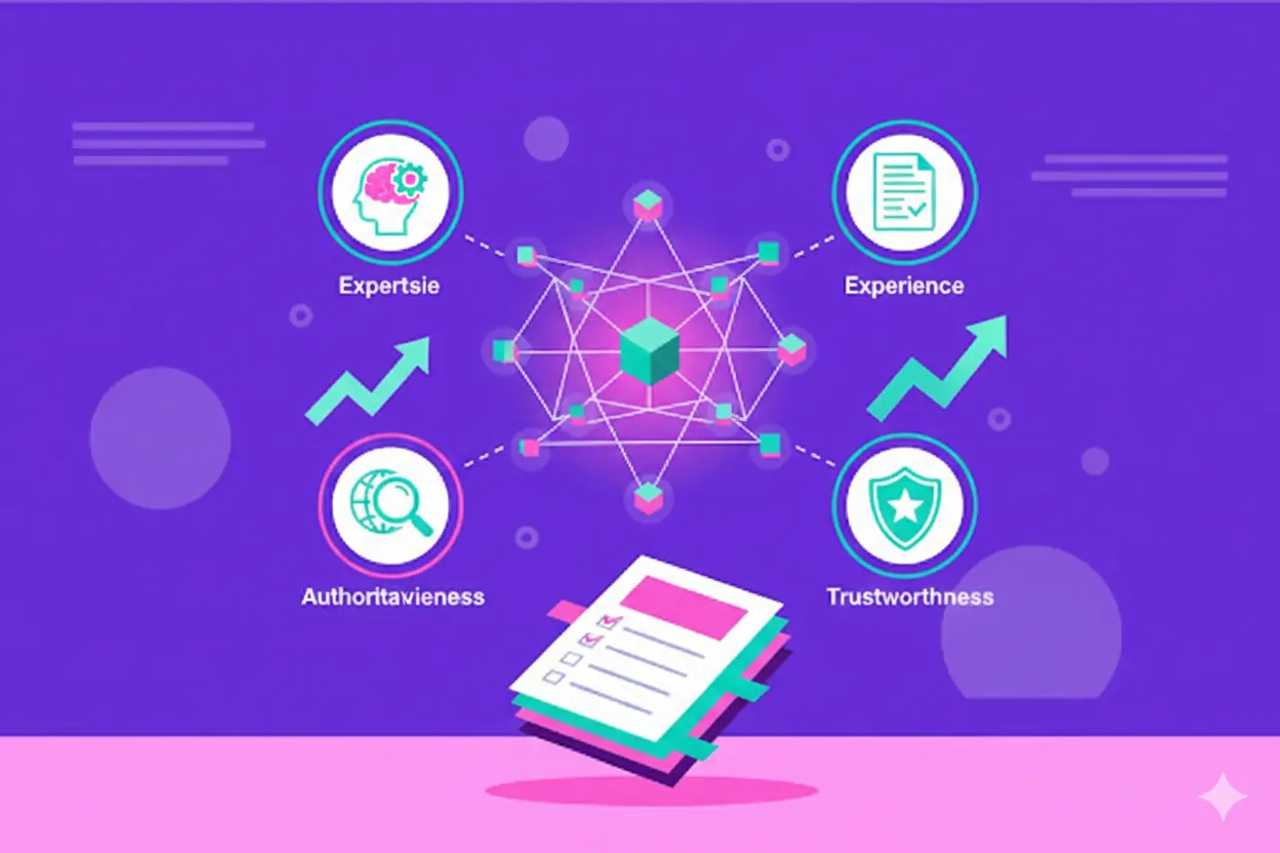
AI Overviews compress the web into a few sentences and cite only sources they trust.
If your E-E-A-T signals are weak or fragmented, you lose visibility and brand demand.
In this guide you will learn how to audit AI Overview citations, align E-E-A-T signals to the way assistants pick sources, and build dashboards that track your share of AI answers.
This matters because AI-first results siphon clicks while shaping brand perception.
Anchor every move to our E-E-A-T evidence-first pillar at E-E-A-T SEO: Evidence-First Playbook for Trust & AI so your proof stays consistent.
How AI Overviews pick sources
Relevance: does the page answer the query in the first 100 words with clear structure.
Trust: recognizable entities with consistent Organization and Person signals across the web.
Experience: specific steps, data, and examples that reduce hallucination risk.
Freshness: recent
dateModified, up-to-date sources, and active authors.Structure: clean headings, lists, and schema that make extraction easy.
Run an AI Overviews E-E-A-T audit
Collect AI Overview results for your priority queries (manual or automated). Record cited URLs, domains, and author names.
Compare citations against your content. Note missing topics and weak E-E-A-T signals.
Check on-page: intro answers, sources, author and reviewer bios, dates, and disclaimers.
Validate schema: Article with Person and Organization, FAQ/HowTo where applicable, Speakable for concise summaries, and
about/mentionsfor entities.Inspect off-site trust: sameAs links, Knowledge Panels, GBP for local queries, and recent PR mentions.
Run prompt tests in Perplexity, Copilot, and Gemini with the same queries; log overlaps and gaps.
Score each query on coverage (do we have content), trust (E-E-A-T strength), and extractability (structure, schema).
Build AI Overview-ready pages
Lead with the answer: define, list steps, or summarize findings in the opening paragraph.
Add proof: data tables, screenshots, case snippets, and citations to primary sources.
Include author and reviewer bios with credentials; show reviewer dates for YMYL topics.
Keep paragraphs tight and skimmable; use clear H2/H3s that mirror query language.
Add FAQs that mirror follow-up questions; use FAQ schema when safe.
Link to supporting pillars, including our E-E-A-T pillar at E-E-A-T SEO: Evidence-First Playbook for Trust & AI, to reinforce authority and give readers depth.
Schema to boost E-E-A-T for AI Overviews
Article/BlogPosting with
author,publisher,reviewedBy,datePublished,dateModified.Person with
knowsAbout, credentials, and sameAs linking to LinkedIn, Scholar, or professional bodies.Organization with stable @id, logo, contactPoint, and sameAs across markets.
FAQ, HowTo, Speakable for extractable answers; VideoObject and ImageObject with captions for media clarity.
LocalBusiness for location-bound intents; align with GBP data and NAP.
Validate rendered output and keep @id stable to avoid fragmented entities.
Content clusters and entity alignment
Group queries by intent (how-to, definitions, comparisons, risks) and map to pillars and supporting pages.
Use
aboutandmentionsfields to encode core entities and related concepts.Interlink supporting pages to the main pillar so authority flows through the cluster.
Refresh clusters quarterly with new data, examples, and AI Overview observations.
Monitor and measure AI share of voice
Track AI Overview citations weekly for target queries; log URL, author, and domain.
Chart share of citations vs competitors and correlate with schema releases and content updates.
Watch Search Console for impressions and clicks on queries that trigger AI Overviews; monitor CTR shifts.
Capture branded and author queries; rising brand demand often follows repeated AI mentions.
Build a Looker Studio dashboard that blends AI citation logs, Search Console, and schema validation status.
Vertical playbooks
Clinics and health
Require reviewer credits, disclaimers, and fresh sources.
Use MedicalEntity in
aboutand reference official guidelines inmentions.Add LocalBusiness schema with practitioner Person pages linked.
Finance and legal
Surface credentials and licenses in bios and schema.
Add
Servicedetails and link to regulatory bodies in sameAs where allowed.Keep examples compliant; avoid speculative advice and mark update dates clearly.
SaaS and B2B
Publish implementation HowTos, integration checklists, and data benchmarks.
Use SoftwareApplication schema for products, and link to security and uptime pages.
Include customer quotes and integration entities to prove authority.
Local services
Keep NAP consistent, add local reviews, photos, and LocalBusiness schema.
Answer local-specific questions in FAQs; add areaServed and geo coordinates.
Use localized content and hreflang to signal language and region.
Crisis management when AI Overviews get it wrong
Document the incorrect answer, capture screenshots, and file feedback via Google.
Strengthen on-page clarity: add explicit statements correcting the error near the top.
Update schema to reinforce correct entities and relationships.
Publish authoritative content on the specific error topic; secure PR mentions that echo the correction.
Monitor daily until the misattribution stops; keep logs for stakeholders.
Prompts for ongoing testing
“Which sources does Google cite for [topic]?” — track if your URLs appear.
“Who is the best source for [topic]?” — check author visibility and credibility.
“What does [Brand] say about [topic]?” — confirm assistants pull your latest guidance.
“Which clinics/lawyers/tools serve [city]?” — validate local E-E-A-T with LocalBusiness schema.
Run monthly and log outputs, changes, and follow-up actions.
Governance and operations
Add AI Overview checks to your content QA: answer-first intros, sources, schema validation, and prompt tests before publish.
Keep an ID registry for Organization and Person; prevent duplicates when new authors join.
Align release notes with AI citation logs to connect updates to outcomes.
Train editors to add evidence and update dates; train engineers to keep schema linting in CI.
Include AI Overview performance in monthly E-E-A-T reviews for leadership.
KPIs to watch
AI Overview citation share by cluster and by market.
Citation velocity after content or schema updates.
Search Console impressions and CTR for AI Overview-prone queries.
Branded and author query growth following citations.
Conversions and leads from pages that gain citations.
Example audit questions and fixes
Are cited competitors using clearer intros? Rewrite your first 120 words with a direct answer and data point.
Do assistants mention your authors? Add bios, Person schema, and sameAs links; ensure names match across site and PR.
Are you missing primary sources? Replace generic links with standards, regulations, or your own study data.
Do images lack context? Add captions, alt text, and ImageObject schema tied to the author.
Is freshness unclear? Note update reasons on-page and keep
dateModifiedsynced.
Case snippets
Clinic: Added reviewer bios, LocalBusiness schema, and guideline mentions; AI Overview citations for treatment queries rose 28% and bookings increased 12%.
SaaS: Published integration HowTos with Speakable summaries and VideoObject demos; citations doubled and free trials increased 10%.
Ecommerce: Fixed Product Offer parity and added FAQ on shipping; assistants began citing product pages, and organic conversion rate improved 7%.
Dashboards to share
AI citation share by cluster and market with weekly trends and annotations for releases.
Query gap list: tracked intents with zero citations and owners assigned.
Schema health: rendered validation pass rates by template.
Freshness tracker: days since update and reviewer date for YMYL pages.
Engagement: CTR and dwell for cited pages vs non-cited peers.
Common mistakes to avoid
Publishing thin summaries without proof; assistants prefer sourced, detailed answers.
Ignoring off-site consistency; weak sameAs and PR reduce trust even with good schema.
Overusing Speakable on YMYL content without reviewers and disclaimers.
Leaving
aboutandmentionsempty; assistants lose entity context and skip you.Letting plugins inject duplicate schema that fragments Organization and Person IDs.
Operations and governance checklist
Pre-publish: answer-first intro, sources cited, author and reviewer attached, schema validated, prompt test captured.
Post-publish: log AI citations for target queries, track Search Console shifts, and review schema parity.
Quarterly: rerun AI Overview audits, refresh evidence and media, and re-score clusters.
Ownership: SEO leads audits, editors own evidence density, engineers own schema QA, PR feeds new sameAs links.
Experiment ideas
Move FAQs higher on page to test extractability; measure citation changes.
Add Speakable summaries on non-YMYL guides; check if assistants quote them.
Place data tables near intros; see if AI answers pull your numbers.
Publish expert quotes with credentials and test prompts such as “According to [Author]…” to see if assistants cite the person.
Localization for AI Overviews
Translate intros, FAQs, and citations with native experts; avoid literal translations of medical or legal terms.
Localize schema
inLanguage, addresses, currencies, and sameAs profiles.Track AI citations per language; some markets roll out AI Overviews later, so baseline early.
Use local sources when available; assistants often prefer regional authorities for local intents.
Integrate with PR and brand
When coverage lands, update sameAs and add quotes to relevant pages to strengthen authority.
Mark up hosted press releases with NewsArticle schema and link to Organization and authors.
Monitor AI answers for brand mentions after PR campaigns to prove impact.
Prompt bank for teams
Editor: “Summarize this page in two sentences” — if the summary lacks proof, add it.
SEO: “Who do you cite for [topic]?” — if not you, inspect cited pages for patterns to replicate.
PR: “Which experts talk about [topic]?” — ensure your spokespeople appear with correct roles.
Local: “Best [service] in [city] open now” — verify LocalBusiness clarity and hours.
Legal/compliance: “Is this advice safe to follow?” — check that disclaimers surface.
Aligning AI Overviews with business outcomes
Map AI citations to funnel stages: awareness (definitions), consideration (comparisons), decision (setup).
Place CTAs near the first answer without blocking readability.
Tag leads from cited pages; show revenue impact of AI visibility in executive reports.
Track branded and author query lift as a proxy for trust gained from AI exposure.
Post-incident recovery steps
If an AI Overview misstates your brand, publish a correction note and link to a detailed post.
Update schema and sameAs to reinforce accurate entities.
Secure PR mentions that restate the correct facts and link to your page.
Monitor prompts daily until the error stops; keep stakeholders informed with logs.
Page template for AI Overview readiness
Hook: one-sentence direct answer with a data point or definition.
Proof strip: 3–5 bullet points with sources, stats, and examples.
Body: H2/H3 structure that mirrors intent types (steps, pros/cons, comparisons).
Trust box: author and reviewer bios, dates, disclaimers, and links to primary sources.